
The Organic Cosmos
A Spacetime Journal Tracking from Electron Uniformity to the Pressure of the Void

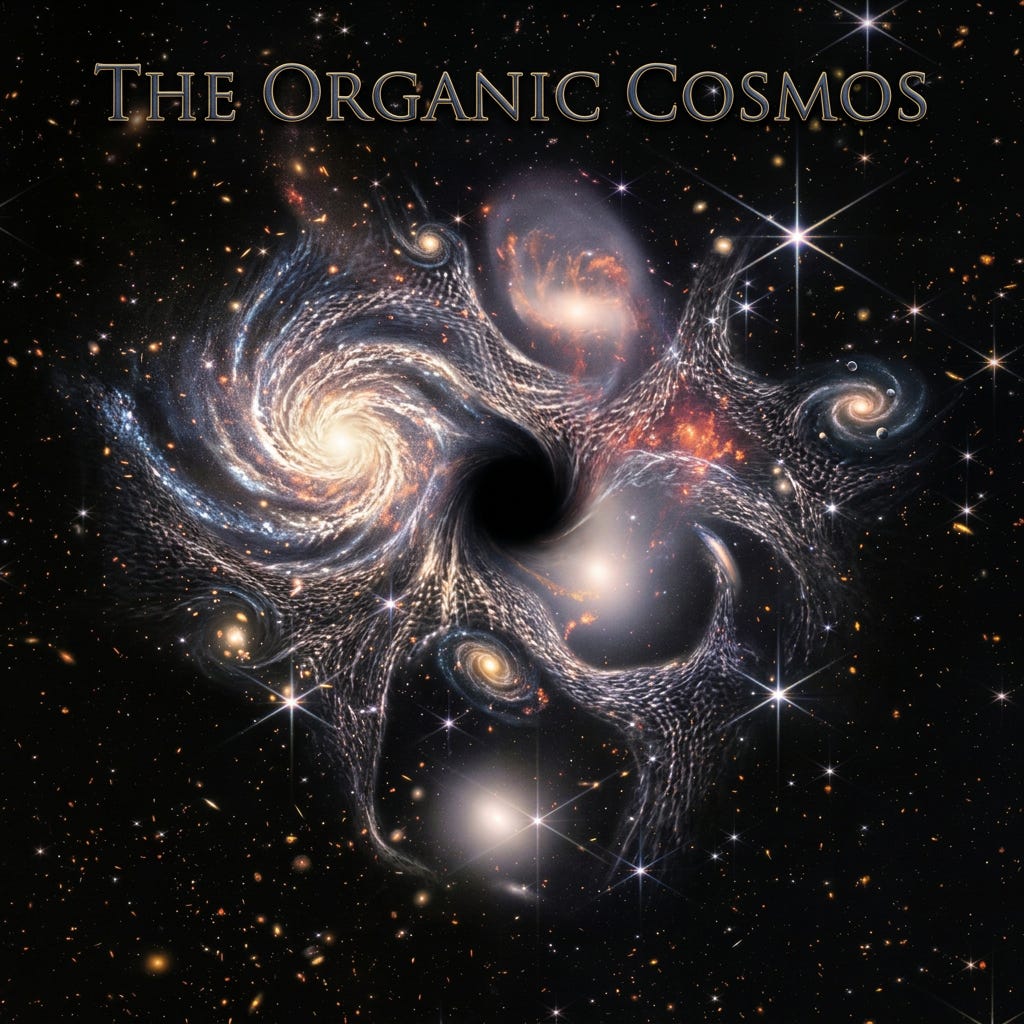
For thousands of years, humanity has viewed the universe through the lens of “particles”—the rigid belief that solid atoms existed first in a barren vacuum, and that their random collisions shaped our reality. Yet, this familiar intuition crumbles completely when faced with one of the simplest, most unsettling questions of the microscopic world:
“Why is every single electron in the universe flawlessly, identically the same?”
Whether it is an electron inside a laboratory on Earth or one at the edge of a galaxy billions of light-years away, its mass, charge, and spin match perfectly to infinite decimal places. How could nature enforce such absolute, eerie standardization on a fundamental particle? In 1940, physicist John Wheeler called his student Richard Feynman in a bout of excitement, proposing a radical idea: “Feynman, I know why all electrons have the same charge and mass... Because they are all the same electron!” He envisioned a single particle weaving backward and forward through spacetime, leaving a complex tapestry where every point of intersection appears to us as a separate electron.
This romantic imagination eventually formalized into the bedrock of modern physics: Quantum Field Theory (QFT). Modern physicists no longer view electrons as tiny, flying billiard balls. Instead, they understand that the universe is thoroughly saturated by a vast, uniform ocean of energy called the “Electron Field.” What we perceive as an individual electron is merely a localized ripple rising from that singular ocean—much like waves in the Pacific and Atlantic are ultimately made of the exact same body of water.
The reason this hypothesis holds absolute logical necessity is that it completely rejects the independent isolation of individual particles. If electrons were truly separate, independent blocks of matter, the turbulent cosmic environment would inevitably cause minor variations in mass among some of them. Yet, no such electron exists. The absolute uniformity of the electron is not an inherent trait of a tiny object; it is the definitive proof that the entire universe is fundamentally connected as a single medium, expressing a uniform, characteristic vibration under specific cosmic conditions.
Chapter 2. The Current of Electricity: Do Electrons Truly Race Through Wires?
We are taught in school that power plants pump out electrons, and that these particles race through copper wires like marathon runners to illuminate the light bulbs in our homes. Yet, when physics measures the actual drift velocity of electrons inside a conductor, they crawl at a speed of mere centimeters per hour—slower than a snail. Why, then, does the light turn on the exact split second we flip the switch? If these sluggish particles are not delivering the energy, what is truly flowing?
To unlock this secret, a wire must not be seen as a highway for traveling particles, but as an aqueduct completely packed with water, or a rope in a tense game of tug-of-war. What the power plant does is not inject new electrons; it grabs one end of an already taut rope and shakes it violently back and forth (Alternating Current). As you shake the rope, a single fiber (an individual electron) merely vibrates in place, but the tension and wave of force travel to the opposite end at the speed of light.
In fact, the most profound equation in electromagnetism—Poynting’s Theorem—mathematically proves that electrical energy does not flow inside the copper wire at all. It streams through the empty space (the field) surrounding the exterior of the wire at the speed of light. The copper wire is simply the boundary wall that guides and traps that energy so it does not bleed away.
As Poynting’s Theorem demonstrates, what travels from the power plant to our homes is not matter, but the state of tension and potential energy within the field. The internal electrons act merely as the initial dominoes or valves that open the aqueduct guide rails. Therefore, electricity is not an analog mechanism of migrating matter, but a systemic transition where wave energy synchronizes across a pervasive electromagnetic medium at the speed of light.
Chapter 3. The Essence of Chemical Bonding: Why Matter Embraces
If the universe is fundamentally a fluid stream of energy, why do certain energies cluster tightly to form the dense, tangible “matter” we can see and touch? Why do oxygen atoms bind with oxygen, and why do carbons interlock to form the rigid lattice of a diamond? What is the primal driving force behind chemical bonds?
The universe is an energy ocean striving to maintain a uniform density. For an isolated, independent atom to exist in the middle of this ocean means it must endure the immense, restorative pressure of the surrounding field from all 360 degrees—a highly tense state, like a balloon submerged deep under water.
However, when two atoms draw close, a geometric transformation occurs. The energy field trapped in the “inner” space between them is squeezed out, creating a “pressure shadow” (shielding effect) where they protect one another. The internal pressure drops precipitously while the external cosmic pressure remains constant. Consequently, the two atoms are forced together by the sheer weight of the surrounding external field.
Modern physics has empirically proven the reality of this spatial pressure through the Casimir Effect, showing that two uncharged metallic plates placed minutely close in a vacuum are pushed together and snapped shut by the pure pressure of the vacuum field. If the inherent vibrations (frequencies) of the two atoms align perfectly, their waves overlap seamlessly, creating a state of perfect resonance—the ultimate definition of a powerful covalent bond.
The binding forces of nature do not originate from mysterious hooks hidden inside matter; they are the inevitable consequence of external spatial pressure. Physics dictates that all systems drift toward their lowest, most stable energy state. This means matter rearranges itself to minimize the pressure it receives from the field. The powerful bond between identical elements is a geometric necessity: their identical frequencies achieve perfect resonance, reducing the field resistance between them to absolute zero ($0$) and neutralizing external cosmic pressure with maximum efficiency.
Chapter 4. Magnetism and Gravity: Unmasking Attracting Forces
How do we explain the invisible forces that push magnets apart or cause the Earth to pull a falling apple? What is the actual, visual mechanism of these immense powers operating across seemingly empty space?
A magnet is simply a piece of matter in a “specific state” where the chaotic, randomly scattered vibrations of its internal atoms have aligned in a single direction. This unified pulse creates a massive, coordinated wave in the energy ocean. When like poles (N-N) meet and their waves overlap, they cause constructive interference. This amplifies the wave amplitude drastically, generating a dense spatial pressure (repulsion) that shoves the magnets apart. Conversely, when opposite poles (N-S) meet, their waves collide out of phase, canceling each other out. The pressure between them collapses into a low-pressure zone, and the overwhelming external pressure snaps them together (attraction).
Gravity operates on the exact same fluid dynamic. A massive object like the Earth shoves the universal energy field outward, carving out its own colossal “cavity” (a vacuum bubble). As you approach the surface of the Earth, the displaced energy grids become tightly compressed, creating a severe asymmetry in field density. To correct this imbalance, the external energy ocean rushes toward the center of the Earth from all directions like a torrential tide. An apple falls not because the Earth possesses a mystical tugging string, but because the cascading tide of the energy field pushes the apple downward. This is the exact mechanism described by physicist Erik Verlinde’s 2010 theory of Emergent Gravity.
Mainstream physics struggles to unify electromagnetism and gravity because it treats them as fundamentally separate forces. Yet, under this fluid model, both are elegantly unified under a single principle: the density differentials of spatial pressure. Magnetism is a pressure shift induced by the amplitude and phase alignment of atomic vibrations; gravity is a pressure shift induced by the geometric density distortion caused by mass. Both forces are merely secondary, emergent phenomena born as the medium flows to correct asymmetrical spatial pressures, aligning perfectly with the thermodynamic laws of fluid systems.
Chapter 5. Constant Light Speed and Quantum Leaps: The Cosmos Woven from a Fraying Blanket
A final set of riddies remains. Why do electrons in the quantum realm refuse to move continuously, vanishing from one orbit and instantly popping up in another without crossing the space between (Quantum Leaps)? And why does light maintain an absolute, unyielding speed of 300,000 kilometers per second ($c$), no matter how fast an observer runs toward or away from it? What kind of architecture forces the cosmos to adhere to such bizarre constraints?
We envision space as a smooth, continuous fabric, but the universal energy field is actually an unraveling, coarse blanket of energy clumps (a quantized state), much like drops of water forming an ocean. Just as a person cannot step on the empty air between the rungs of a ladder, energy itself is divided into minimum indivisible units. The electron has no choice but to bypass the intermediate space entirely, skipping from one energy tier to the next in a discrete Quantum Leap.
The immense pressure filling the gaps between these energy fibers is none other than Dark Energy (the void), the engine driving the accelerated expansion of the universe. Pushed by the pressure of this internal void, the universal energy field is never a static stage; it behaves as a single, colossal, living organism in constant flux.
The grand, sweeping pulse of this organism as it rolls from past to future is what we call “Time,” and the vibration traveling along the grain of this temporal flow is “Light.” The speed of light remains absolute regardless of an observer’s velocity because acceleration is an act of wading against the torrent of the “Time Field,” which flows resolutely at $c$.
Just as moving violently against a powerful aquatic current maximizes physical resistance, an object accelerating through spacetime experiences the dynamic drag of the field. This drag manifests precisely as Time Dilation and the constancy of light speed. Ultimately, the quantum leap of the microscopic world (the grain of the energy blanket) and the relativity of the macroscopic world (the fluidity of time) are not clashing laws, but the internal and external expressions of a single, grand cosmic fabric responding to the relentless pressure of the void.
Epilogue: The Inverted Universe
Viewed through the Organic Cosmos, the architecture of reality is breathtakingly unified.
The primal density of the void (Dark Energy) pushes against the cosmos to create a massive, structural flow. Within this web-like current, energy clumps aggregate into the sweeping filaments of galaxy clusters. The momentum along these filaments triggers cosmic eddies, spinning up the rotating whirlpools we call galaxies, at the fringes of which settle the minute, pressure-stabilized pockets of solar systems. Deep within those calm sanctuaries, subatomic particles surfing the vibrational waves of the time axis accumulate their movements, scaling up to interact once more with the macroscopic electromagnetic fields.
Humanity has long been blinded by the visible scenery (matter), failing to notice the grand ocean altering the stage (the field and its pressure). The universe is not a barren room furnished with solid objects. It is a single, colossal, living ocean where energy weaves, flows, and continuously seeks equilibrium atop a torrent unleashed by the pressure of an invisible void. This is the true face of the Organic Cosmos in which we reside.